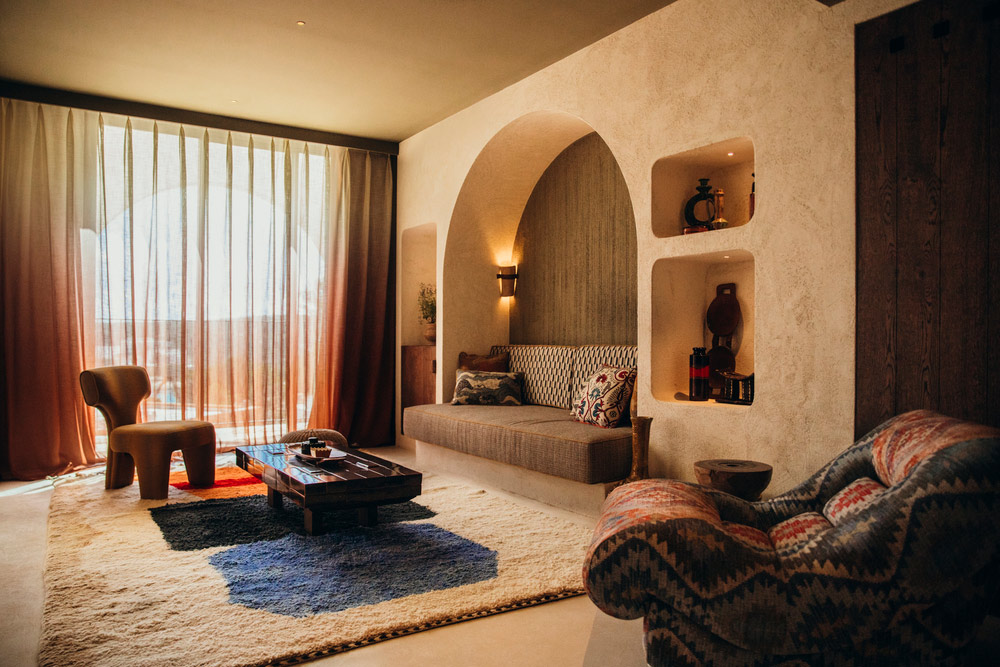
“Legado de Ultramar” reinterprets Baiona’s maritime memory through a contemporary lens, bringing together Galician craftsmanship, fine materials and an intervention designed to complement Monterreal Fortress.
Madrid, September 2026. — CIDON Interior Design & Contract has been awarded the interior design and furnishing project for Parador de Baiona, set within one of the most iconic landmarks of the Rías Baixas: Monterreal Fortress.
The intervention will encompass guest rooms and several shared spaces, including the central gallery, breakfast room, Salón de los Relojes (Clock Room) and corridors. Work will be phased to allow the hotel to remain open.
CIDON’s approach is rooted in restraint, seeking to complement rather than transform what is already there. This thinking gave rise to “Legado de Ultramar” — “A Legacy from Across the Atlantic” — the concept developed for the project. It draws on Baiona’s historic relationship with the Atlantic. For centuries, the town was a place of voyages, trade, arrivals and departures. This maritime character is integral to its identity, with one of its most symbolic moments occurring in 1493, when the caravel Pinta reached its harbour carrying news of the voyage across the ocean.
This history of exchange between Galicia and lands across the Atlantic led the CIDON team to a later chapter in Galician history: that of the indianos, emigrants who crossed the Atlantic and returned with new influences, materials and ways of approaching domestic architecture.
The interior design takes this Atlantic connection as its guiding thread and translates it into a contemporary language. From that legacy, it draws a sense of light, an appreciation of craftsmanship, fine materials and understated elegance, balancing memory and the present without literally recreating the past.
“In Baiona, we understood from the outset that the project should complement its setting rather than impose itself. We have respected the existing woodwork, worked with materials that bring warmth and avoided adding layers that might diminish the building’s presence. The idea is that guests should remember where they are first and foremost.”
This approach also informs the layouts and furniture selection. In the guest rooms, compositions are arranged to keep views to the outside clear, while furniture with restrained proportions and calm lines supports the space without competing with the architecture.
The project’s material approach begins with elements capable of creating a natural continuity with the existing architecture.
Chestnut wood, stone, ceramics, metal and natural-looking textiles form a calm palette inspired by the colours of the Galician landscape: stone, sand, wood, ecru and soft greens. Rather than following trends, the selection favours materials that can age gracefully and endure.
Wood brings warmth to the fortress’s imposing character; stone maintains the connection with the original architecture; and ceramics, textiles and selected lighting details introduce subtle references to the world of the indianos and to traditional craftsmanship.
One of the proposal’s central elements is the inclusion of Galician craftsmanship and creative work with a cosmopolitan outlook.
CIDON has worked on selecting artists, workshops and suppliers connected to the region, with the aim of integrating pieces created specifically for the Parador and making interior design a new way of engaging with local culture.
Planned collaborations include Clandestine Ceramiques, which will develop ceramic pieces and a bespoke artwork for the Salón de los Relojes, alongside Maruxa Caeiro, whose contribution will be conceived specifically for the hotel’s guest rooms.
The intention is to make craftsmanship part of the project’s narrative, rather than treat it as an added decorative layer. Ceramics, illustration, wood and objects made through artisanal processes bring place, memory and culture into the guest rooms and shared spaces.
This connects directly with one of the proposal’s core principles: heritage is not only what is preserved; it is also what continues to be created.
The project includes the restoration and integration of selected existing elements, understanding sustainability in terms of both the origins of materials and their capacity to endure and remain part of the building’s life.
Rather than systematically replacing what is already there, the proposal seeks to recognise what deserves to stay and bring it into dialogue with new pieces and contemporary solutions.
This philosophy also allows for different levels of intervention in the historic areas and the more recent parts of the Parador. The architecture changes, but the identity remains: shared principles of materiality, tranquillity, comfort and connection with the landscape ensure that guests do not feel they are experiencing two different hotels.
Alongside the creative development, CIDON will deliver the project through bespoke furniture, supplier selection and coordination, furnishing and installation, within an intervention that must coexist with the hotel’s day-to-day operations.
Under the current schedule, work will be organised in three phases between November 2026 and April 2027, allowing the Parador to remain operational throughout.
This complexity takes the project beyond interior design and into the field of contract delivery: translating a concept into hundreds of decisions on manufacturing, supply, logistics and installation without losing the original design intent along the way.
With “Legado de Ultramar”, CIDON proposes an intervention in which heritage and the present are not treated as opposites. The aim is for architecture, landscape, materials and craftsmanship to help guests understand Galicia a little better from within the Parador itself.